
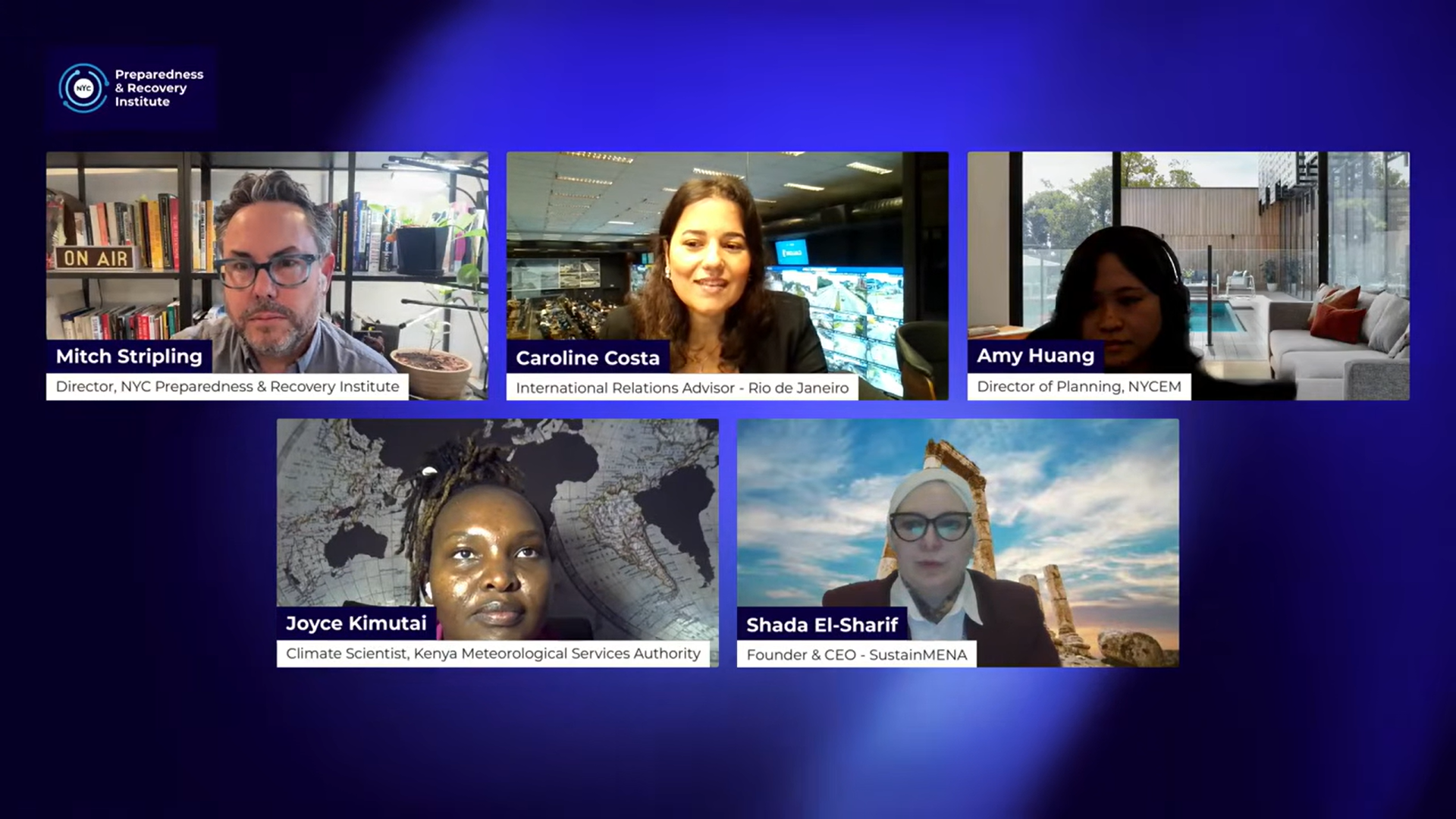
On October 6th, the New York City Preparedness & Recovery Institute (PRI) hosted a webinar, in collaboration with Columbia Global, and the Columbia Climate School, titled “El Niño: How Global Cities are Preparing for an Inevitable Threat.” Leaders from New York City, Rio de Janeiro, Nairobi, and Amman discussed how cities can brace for the coming El Niño event. Panelists drew on experience across government, academia, and business to examine the potential impacts on health, food systems, and civil infrastructure.
Featuring:
- Jeffrey Shaman, PhD, Professor of Climate, Climate School & Co-Lead, PRI Epidemiology & Modeling Team
- Amy Huang, BS, NYC Emergency Management (NYCEM)
- Caroline Costa, MBA, Resilience and Operations Center of the City of Rio
- Joyce Kimutai, PhD, Kenya Meteorological Service Authority
- Shada El-Sharif, MPA, SustainMENA
- Moderated by Mitch Stripling, MPA, NYC Preparedness & Recovery Institute
Key Takeaways
The threat is real, but the details are uncertain
- Multiple epidemiological forecasts show that this could be the most severe El Niño on record, according to keynote speaker Jeffrey Shaman. But forecasts this far out can’t pin down the details, so cities “have to plan for a number of eventualities.” Rio, for example, doesn’t yet know whether to expect heavy rain, extreme heat, or both.
- Risks differ by city: landslides and flooding in Rio, multi-hazard winter weather in NYC, above-normal rainfall already hitting Nairobi, and water stress, flash floods, and heat in Amman.
- Heat is a major concern. It is the leading cause of weather-related deaths in North America, and El Niño drove major Northern Hemisphere heat waves this past summer.
- Aligned forecasts and lead time before the Southern Hemisphere summer give cities a chance to act before disaster strikes.
Preparing amid uncertainty
- Amman: Creating an updated climate action plan, flood risk mapping, nature-based solutions (green spaces that act as “sponges” in flood-prone areas), drain checks, and early warning system testing. As El-Sharif stressed, “Data is really important to this conversation.”
- Rio: Generating a new 5-level heat index built from hospitalization data, and a summer resilience plan (Nov–Apr) spanning city agencies; already established 164 sirens across 102 communities that direct residents to safe paths.
- NYC: Expanding cooling and heating centers to libraries, museums, and malls, tailoring outreach and early warning system operations to vulnerable populations, and working with local, state, private, and nonprofit partners on seasonal forecasts.
- Nairobi: Bolstering inter-agency coordination among the Red Cross, Ministry of Health, and Disaster Management authority.
- Cities can also learn from each other. After Nairobi and Rajkot, India compared action plans, one standout strategy was Rajkot’s hospital wards dedicated to climate-exacerbated health issues during hot seasons.
Financing as an investment
- Framing measures like early warning systems as long-term climate adaptation can help cities win private and international funding, especially in the Global South.
- Kimutai promoted “blended finance,” pooling resources from multiple stakeholders, since weather events affect every sector. Governments may also need to redirect money from other sectors, such as health.
- Public-private collaboration is especially important in Africa, where debt limits many countries’ ability to invest. International student solution-building competitions can also spur innovation and attract donor funding.
Communication is key
- Cities must partner with vulnerable populations, such as people in informal settlements, so they aren’t left behind.
- Costa highlighted social media’s potential to expand reach, but noted that traditional media remains essential for people without smartphones.
- Huang noted that NYC’s “Strengthening Communities” program empowers leaders from about 8,000 nonprofit partners to serve as trusted messengers and build local emergency preparedness plans.
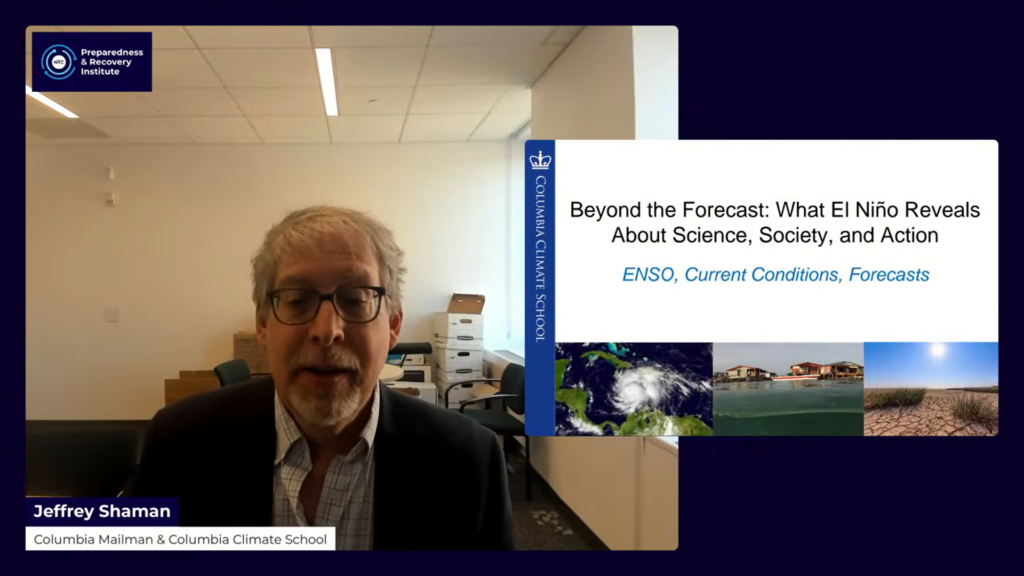
As Jeffrey Shaman shared in his final remarks, “We communicate in order to share information and learn from one another.” The panelists shared a wealth of information about what global cities can learn from each other’s climate emergency preparedness plans in the midst of uncertainty and opportunities for both innovation and better community engagement. Turning this knowledge into actionable strategies is critical to public health practice and promoting resilience in the months to come.
Watch a recording of the full webinar on YouTube and LinkedIn.